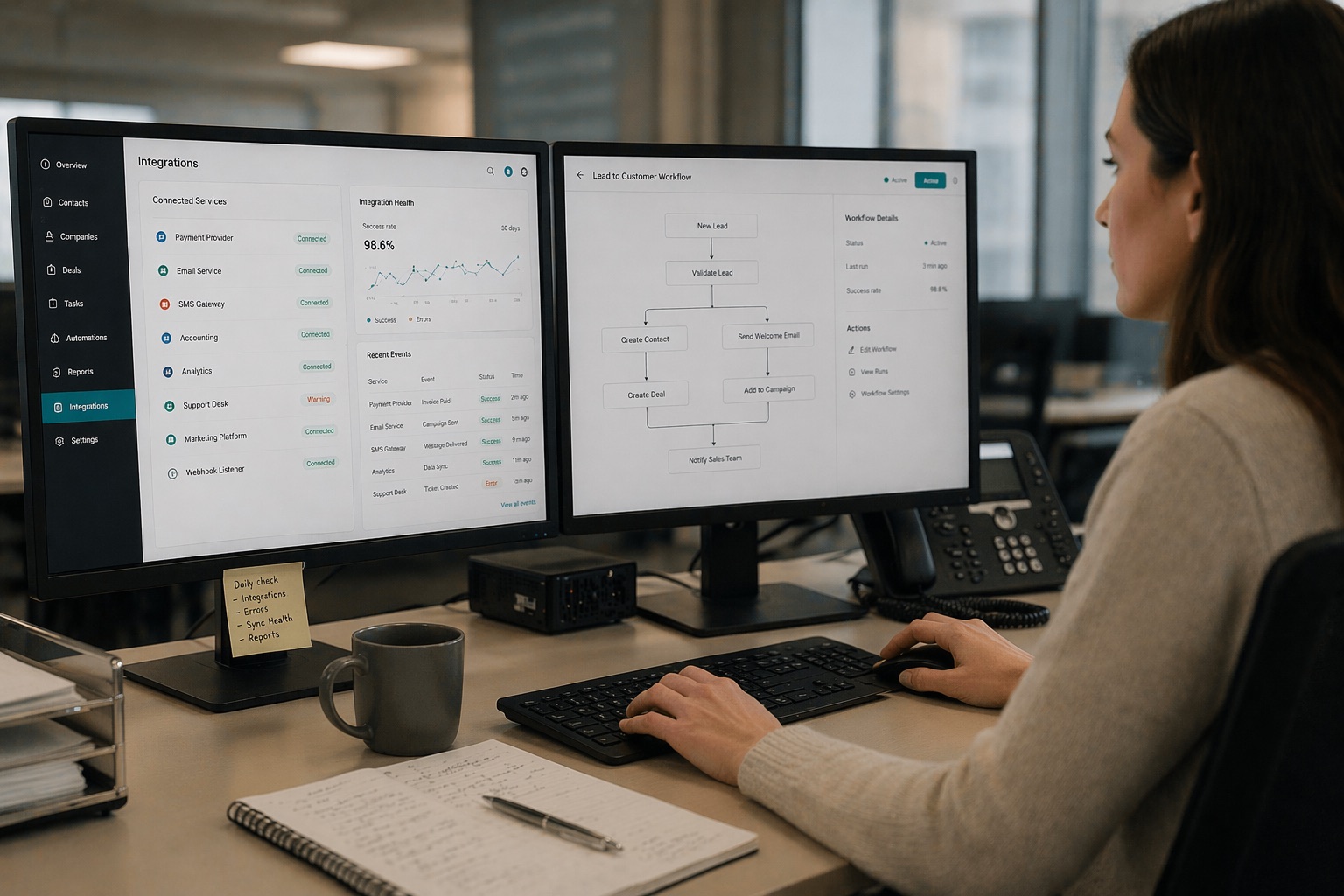
Backend & Integrations
CRM integrations
Developing modules that connect an internal CRM to external services: payment systems, email marketing, and analytics, where predictable and reliable data exchange matters.
Service
I design and implement AI bots and AI assistants that help small and medium-sized businesses respond to customers faster, handle inquiries, find information, and reduce routine manual work.
Where it helps
Support teams spend a lot of time on repetitive questions, order statuses, consultations, and initial inquiry triage.
Inquiries arrive through different channels, get lost in conversations, or require manual entry into CRM, spreadsheets, and internal systems.
You need to assess AI's value safely: start with an audit, build a pilot, measure the impact, and only then expand automation.
Scenarios
An AI support bot that answers common questions and hands complex inquiries to a human agent.
An FAQ bot powered by a knowledge base, website, documents, procedures, or service terms.
Collecting and qualifying inquiries for transfer to CRM, Telegram, email, or spreadsheets.
Checking the status of an order, booking, inquiry, or payment through backend integration.
A CRM assistant for managers: concise summaries, suggestions, information retrieval, and draft replies.
A human-agent assistant that suggests answers while leaving the final decision to a person.
What's included
A process audit: where AI will actually reduce routine work, and where a person or conventional automation is the better choice.
Designing scenarios, response rules, the knowledge base, fallback logic, and handoff to human agents.
Developing an AI bot or AI assistant integrated with Telegram, a website, CRM, backend, spreadsheets, and APIs.
Setting up RAG search across documents, knowledge bases, procedures, products, or internal data.
Choosing hosting: cloud models for a fast launch, or an internal environment for privacy and data control.
Result
Fewer manual answers to recurring questions and a lighter support workload.
Faster handling of inquiries, requests, and initial consultations.
Fewer lost leads through a consistent flow for collecting data and passing it to working systems.
Clear escalation logic: the bot knows when to hand a question to a person.
A foundation for gradual AI adoption without abruptly rewriting every process.
Process
We examine the business process: which inquiries recur, what data is available, and where time or inquiries are currently being lost.
We choose the pilot format: support, FAQ, inquiries, a CRM assistant, document search, or an assistant for human agents.
We build the first working version with a limited scope, logging, response rules, and a clear path for escalation to a person.
We test the pilot on real inquiries, refine the knowledge base, and decide which scenarios to expand next.
Control
I do not promise a magical autopilot: first I define the scenarios, data sources, responsibilities, and quality criteria.
For questions where the AI is unsure, I build in a fallback: clarification, an answer source, a task for a human agent, or manual review.
Logging and error analysis are needed from the first pilot so the bot improves through real inquiries instead of remaining a demo widget.
If the data is sensitive, we can consider on-premises hosting or a hybrid setup that avoids sending unnecessary information to external APIs.
Stack
I choose the stack around the scenario and its constraints, rather than an impressive list of technologies.
FAQ
Brief answers to questions that usually come up before work begins.
Contact
Start with an audit or pilot: we will examine support, inquiries, and internal processes, assess automation scenarios, and choose a safe first step.